
If you’ve recently noticed changes in your hair or scalp, you may be wondering if it’s just stress, aging, hormones—or something more.
That was exactly where I found myself years ago.
One of the biggest challenges with Central Centrifugal Cicatricial Alopecia (CCCA) is that many women don’t recognize the early warning signs. By the time they realize something is wrong, permanent hair loss may have already begun.
The good news is that recognizing the signs early gives you the best opportunity to protect the healthy hair follicles you still have.
Here are seven early signs you should never ignore.
1. Tenderness or Pain on the Scalp
Your scalp shouldn’t hurt.
Many women with CCCA describe tenderness when brushing their hair, styling it, or even resting their head on a pillow.
This discomfort is often one of the earliest signs that inflammation is occurring beneath the surface.
2. Burning, Stinging, or Itching
A healthy scalp shouldn’t constantly burn or itch.
While occasional itching can have many causes, ongoing burning, stinging, or soreness deserves attention, especially if it’s happening near the crown of your head.
These symptoms may signal active inflammation.
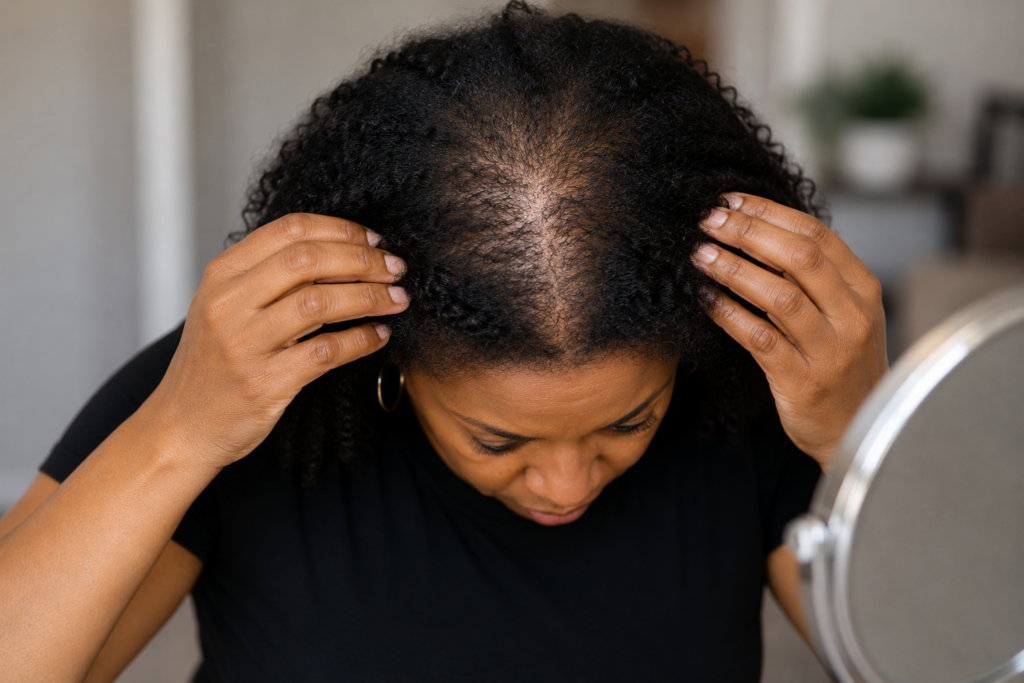
3. Hair Thinning at the Crown
CCCA typically begins near the center of the scalp and gradually spreads outward.
You may notice:
- Your part becoming wider.
- More scalp showing than before.
- Hair that no longer feels as full around the crown.
Many women don’t notice these changes until they compare older photos.
4. Increased Hair Shedding or Breakage
Not everyone with CCCA experiences excessive shedding.
Some women simply notice that their hair seems thinner over time or isn’t growing like it once did.
If you’ve been seeing more hair on your pillow, in the shower, or in your comb, it’s worth paying attention.
5. Hair That Seems to Stop Growing
One of the most frustrating signs is feeling like your hair never gets any longer, no matter how gently you care for it.
In reality, ongoing inflammation can interfere with the hair growth cycle, making it more difficult for healthy hair to grow. If left untreated, some follicles may become permanently damaged and stop producing hair.
6. A Shiny or Smooth Area on the Scalp
As CCCA progresses, areas of the scalp may begin to look smoother or shinier than the surrounding skin.
This can indicate scarring has occurred.
Because scarring hair loss is permanent, early evaluation by a dermatologist is especially important.
7. You Just Know Something Isn’t Right
Sometimes your intuition notices changes before anyone else does.
Maybe your parts are wider.
Maybe your stylist comments on your crown.
Maybe your scalp simply doesn’t feel like it used to.
Trust yourself.
You know your hair better than anyone else.
What Should You Do If You Notice These Signs?
Don’t panic.
Not every scalp problem is CCCA.
However, these symptoms deserve evaluation by a dermatologist, preferably one familiar with hair loss disorders.
The sooner you understand what’s happening, the sooner you can begin protecting your scalp.
My Biggest Piece of Advice
Looking back, I wish someone had told me to take my symptoms seriously sooner.
I spent months convincing myself it was stress, hormones, or something that would simply go away.
If you’re noticing changes in your scalp, don’t ignore them.
Early action matters.
Final Thoughts
Don’t ignore what your scalp is trying to tell you. If you’ve noticed one or more of these early signs, don’t wait and hope they’ll go away. Early evaluation and treatment can make a meaningful difference in protecting your hair and slowing the progression of CCCA. You deserve answers, and you deserve a plan.
About the Author
Hi, I’m Tonya Renee, founder of Tonya Renee Trichology. My passion for CCCA is deeply personal. After living with this condition myself, I decided to pursue formal education in trichology so I could better understand CCCA and help other women recognize the signs early. My mission is to educate, encourage, and empower women to take action before permanent hair loss occurs.
Disclaimer: This article is for educational purposes only and should not be considered medical advice. If you’re experiencing hair loss or scalp symptoms, consult a qualified healthcare professional or dermatologist for evaluation and treatment.