

If you’ve recently heard the term CCCA—or you’re wondering whether it could explain the thinning at the crown of your scalp—you may have a lot of questions. What exactly is CCCA? What causes it? Can it be treated? In this article, I’ll explain what CCCA is, who it affects, what causes it, and why early diagnosis matters—all in plain English.
CCCA (Central Centrifugal Cicatricial Alopecia) is a form of scarring hair loss that primarily affects Black women. It often begins at the crown of the scalp and can slowly spread outward if left untreated. The good news is that recognizing it early gives you the best chance of slowing its progression and protecting the healthy hair you still have.
What Does CCCA Stand For?
CCCA stands for Central Centrifugal Cicatricial Alopecia.
Let’s break that down:
- Central means it usually starts near the center or crown of the scalp.
- Centrifugal means it gradually spreads outward.
- Cicatricial means scarring.
- Alopecia simply means hair loss.
In other words, CCCA is a type of scarring hair loss that typically begins at the crown and slowly expands if left untreated.
What Happens During CCCA?
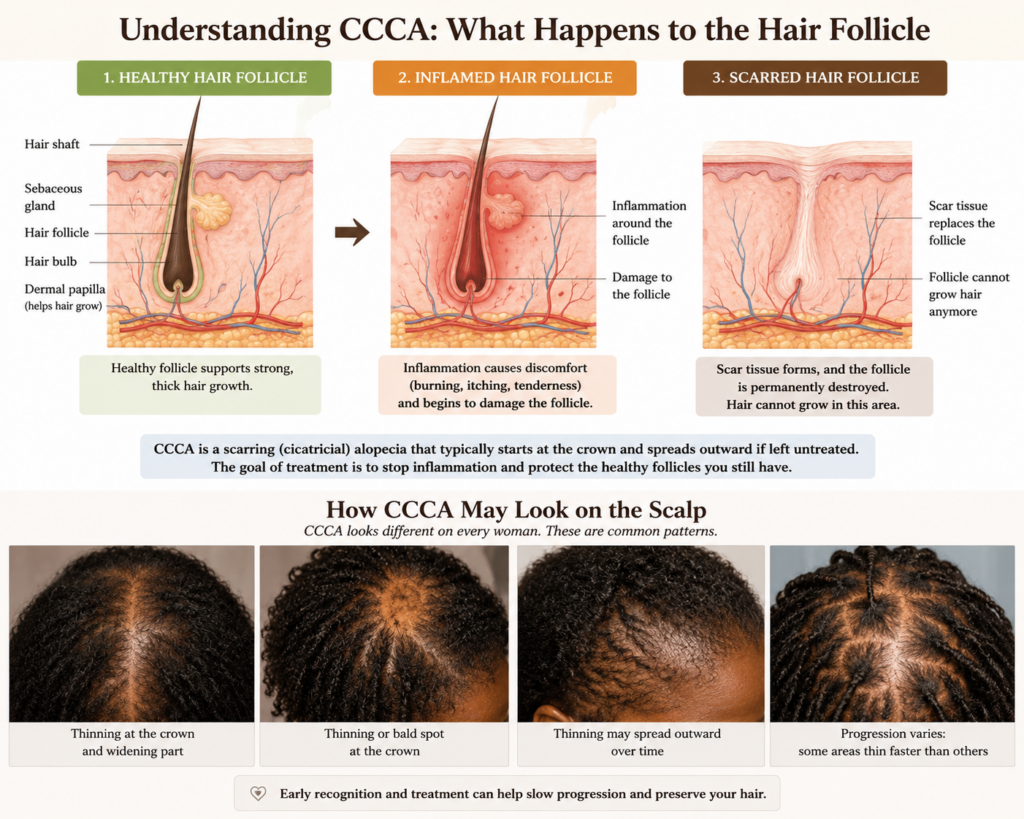
CCCA is considered an inflammatory condition that affects the hair follicles.
Over time, inflammation can damage the follicle. If enough damage occurs, scar tissue can replace the follicle, making it unable to produce hair.
This is why early diagnosis is so important.
The goal isn’t simply growing hair.
The goal is protecting the healthy follicles that are still alive.
What Are the Symptoms?
Not every woman experiences the same symptoms.
Some women notice:
- Hair thinning at the crown
- Burning
- Tenderness
- Itching
- Stinging
- Increased hair breakage
- A widening part
- Hair that seems to stop growing
Others may have very few symptoms until they notice thinning.
That’s one reason CCCA can sometimes go undiagnosed in its early stages.
Who Gets CCCA?
CCCA is seen most often in women of African descent, although it can occur in other populations as well.
Researchers are still studying exactly why it develops.
Several factors may play a role, including:
- Genetics
- Inflammation
- Certain hair care practices
- Hormonal influences
- Other biological factors that researchers are continuing to investigate
Having one or more of these factors does not necessarily mean someone will develop CCCA.
Is CCCA Permanent?
This is one of the most common questions women ask.
The answer is:
It depends.
Once a hair follicle has been replaced by scar tissue, that follicle generally cannot produce hair again.
However, many women still have healthy follicles that can be protected.
That’s why seeking treatment early is so important.
The sooner inflammation is addressed, the better the opportunity to preserve the hair you still have.
Can Hair Grow Back?
Some women experience noticeable improvement after beginning treatment, especially when CCCA is identified early.
Treatment may help reduce inflammation, slow progression, and support healthier hair growth from follicles that remain active.
Every person’s experience is different.
There isn’t a one-size-fits-all outcome.
How Is CCCA Diagnosed?
A dermatologist typically diagnoses CCCA by:
- Reviewing your medical history
- Examining your scalp
- Looking closely at the pattern of hair loss
- Sometimes performing a scalp biopsy to confirm the diagnosis
If you’re concerned about your scalp, don’t hesitate to ask questions during your appointment.
How Is CCCA Treated?
Treatment plans vary from person to person.
Your dermatologist may recommend therapies aimed at reducing inflammation and protecting the remaining hair follicles.
In addition to medical treatment, many women also benefit from supportive habits such as:
- Gentle hair care
- Reducing tension on the hair
- Managing stress
- Eating a balanced diet
- Following their treatment plan consistently
My Biggest Piece of Advice
When I was diagnosed, I was terrified.
I thought “scarring” meant there was nothing I could do.
Thankfully, I learned that while CCCA is a serious condition, there are still steps you can take to protect your scalp and care for your hair.
Learning about my diagnosis gave me back something I desperately needed:
Hope.
Final Thoughts
A CCCA diagnosis does not mean you will lose all your hair.
It simply gives you information.
And information allows you to make informed decisions about your hair and scalp health.
Take things one step at a time.
Find a healthcare team you trust.
Stay consistent.
And remember that caring for your scalp is a journey, not a race.
Think You May Have CCCA?
If what you’ve read sounds familiar, the next step is to schedule an evaluation with a dermatologist who has experience treating hair loss or with a qualified trichologist. Early evaluation is important because CCCA is a form of scarring alopecia, and timely care may help preserve healthy hair follicles.
If you’d like guidance as you navigate this journey, I’d be honored to support you. During a one-on-one coaching session, I’ll help you better understand CCCA, prepare thoughtful questions for your dermatologist, review your current hair-care routine, and develop healthy scalp-care habits that support your overall scalp health.
Book a One-on-One CCCA Coaching Session
Not quite ready for coaching? Visit my homepage and download my FREE 3-Day Scalp Fire Soothing Blueprint to learn simple daily habits that can help calm your scalp while you take the next steps toward professional evaluation and care.
About the Author
Hi, I’m Tonya Renee, founder of Tonya Renee Trichology.
After being diagnosed with CCCA in 2014, I made it my mission to understand the condition and help other women navigate it with knowledge and hope. As a student trichologist, I share educational resources designed to help women better understand CCCA, care for their scalp, and feel more confident throughout their hair journey.
Calmer Scalp First. Growth Second.
Because healthy hair begins with a healthy scalp.
With hope,
Tonya Renee
Student Trichologist | Future Certified Trichologist
Helping women with CCCA understand their scalp, calm inflammation, and protect the hair they have.
Disclaimer: This article is for educational purposes only and is not intended to diagnose, treat, or replace medical advice. Always consult a qualified healthcare professional or dermatologist regarding your individual condition.